November 8, 2018, Vogue.co.uk publish onto their site an interview given by writer Nicole Phelps with the chief marketing officer of L Brands (the parent company of Victoria’s Secrets, or VS), Ed Razek, and the executive vice president of VS Public Relations, Monica Mitro.
The wide-ranging interview primarily focused on the brands’ relevance in an increasingly inclusive lingerie market that’s heralded by Rihanna’s Savage X Fenty. Seemingly unthreatened by such competition, Razek explained their choices for not including a more varied body-type in their selection of models:
“Shouldn’t you have transsexuals in the show?"
Razek: "No. No, I don’t think we should".
"Well, why not?"
Razek: "Because the show is a fantasy. It’s a 42-minute entertainment special.”
Reminiscent of Kim Kardashian’s People Magazine cover, the article almost broke the Internet. Bloggers, activists, influencers and just about anyone with a Twitter account were furious and staged a virtual riot. Razek’s PR team went into a meltdown and he was forced to publicly apologise – an action that leads back to the interview, in which Razek explained his thinking behind making certain business decisions with the self-directed question,
“And did we include them to shut up a reporter?”
The VS show itself didn’t air until December 8, 2018, upon which it received its lowest ever ratings. ABC reported that their viewers had plummeted from 5 million the year before to a meager 3.3 million. This occurred despite their inclusion of social media influencers who have ten times that amount of followers on Instagram, such as Kendall Jenner or the Hadid sisters.
In the weeks that have followed, there have been numerous trans activists and models speak out against the incident.
Carmen Carrera has had a petition started for her to be included in the show.
Nikita Dragun went on to release a
fiercely sexy video in which she dons wings and lingerie, captioned “dear Victoria’s Secret, you said trans women can’t sell the “fantasy” so here I am as a TRANS WOMAN selling the FANTASY!” It’s utter sauce.
[caption id="attachment_41132" align="aligncenter" width="400"]

Nikita Dragun dressed as an Angel in her video[/caption]
Neither of these women would look remotely out of place in a 2019 VS line-up. They’re both insanely beautiful, with legs comparable to sky scrapers, perfectly round boobs and tiny waists. Their appearance is almost totally in tune with the 70-year-old Razek’s vision of how a woman should look.
Yet, what about the women – trans and cis – who don’t fit into this lingering physical ideal propelled forward by a patriarchal society?
In 2016, Ashley Graham was actually ignored by VS after posting onto social media an illustration of her as their first plus-sized model to walk this show – despite the image reaching hundreds of thousands of people. Bear in mind that Razek’s response to this is that L Brands have segregated larger models to another lingerie brand,
Lane Bryant, and tried to televise a plus-size show back in 2000 but “
No one had any interest in it, still don’t”.
Yep, he has been using the same argument for almost twenty years.
[caption id="attachment_41134" align="aligncenter" width="300"]
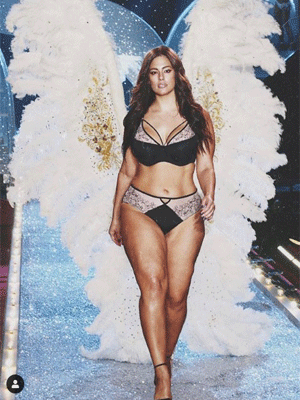
Ashley Graham with her photoshopped Angel's Wings[/caption]
Disabled models haven’t even had a look in yet with their inclusion into the fashion industry being even slower than that of trans and non-binary people. Madeleine Stewart told Teen Vogue that it would be her “biggest dream” to be the first model with Down’s Syndrome to be featured in the Victoria’s Secret exclusive line-up.
Yet, with declining ratings and a muddied reputation, why do women still want to represent or support VS? These being a company who have made their name with the creation of a glorified beauty pageant. The Instagram generation are pushing for realist representations from brands. The international lingerie market is blossoming with inclusivity, with brands such as Savage X Fenty, Lonely Lingerie and TomboyX leading the way. Meanwhile, ThirdLove, a label that was invested in by an ex-VS CEO claims to create “Bras and underwear for every body” with their #WeAreAllAngels social media campaign. There’s still a long way to go for the lingerie market to be more woman-friendly and intersectional, but why don’t consumers and influencers start by supporting brands who truly support and promote them – rather than try to resuscitate a cis-man’s wet dream.
If Victoria’s Secrets want any hope of staying relevant, it’s time for them to make space for the female fantasy.